
Momentum: Timor-Leste forges a vibrant future
Confidence
How do you build a nation from the ashes of conflict? You gain confidence.
In 1999, Timor-Leste had no functioning state institutions and few Timorese had the experience to build and run a country. Timorese leaders asked the United Nations and other international organizations to help them gain the knowledge and skills needed to build institutions of state.
The people of Timor-Leste received support in policing, justice, finance, education, health, human rights, civilian oversight of security forces and many other areas. With more than a decade of experience and many achievements behind them, the Timorese are today confident in their ability to solve problems.
One significant achievement was the establishment of the Timor-Leste Petroleum Fund in 2005. The Fund provides a solid foundation for the wise use of the country’s petroleum resources for current and future generations.
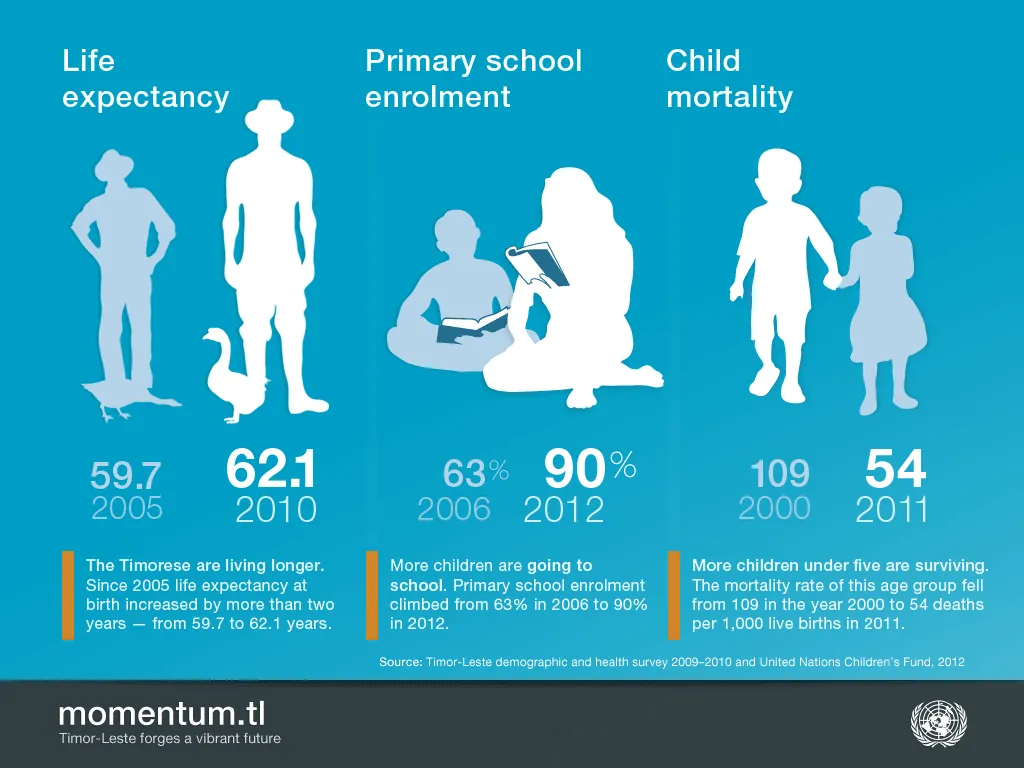
Since the 2002 Restoration of Independence, Timor-Leste has increased life expectancy, decreased child mortality, boosted school enrolment and reduced illiteracy.
Timor-Leste has built and continues to strengthen the institutions that support democracy and ensure law and order. In 2012, Timor-Leste’s national electoral management bodies ran successful elections with much less international support than in previous elections. The National Police of Timor-Leste ensured a secure space for election campaigns, voting and the formation of the new government. The nation’s fifth constitutional government and parliament are at work.
Timor-Leste’s Strategic Development Plan 2011-2030 sets out the country’s aspiration for a diversified and socially inclusive economy that envisages substantial increases in quality of life, health and education standards.
Timor-Leste’s confidence has grown so much stronger that it is reaching out to other countries that are making the transition from conflict to development. The police and military of Timor-Leste today contribute to UN peacekeeping missions in other nations. Timor-Leste’s momentum is also seen in its leadership of the g7+, a group of fragile and conflict-affected states that influences global policy. Through the g7+, Timor-Leste is a key contributor to the New Deal for aid effectiveness.
Resources
- The g7+
- National Petroleum Authority of Timor-Leste
- National Statistics Directorate
- Alola Foundation
- TimorAid